
WIND AND TIDES
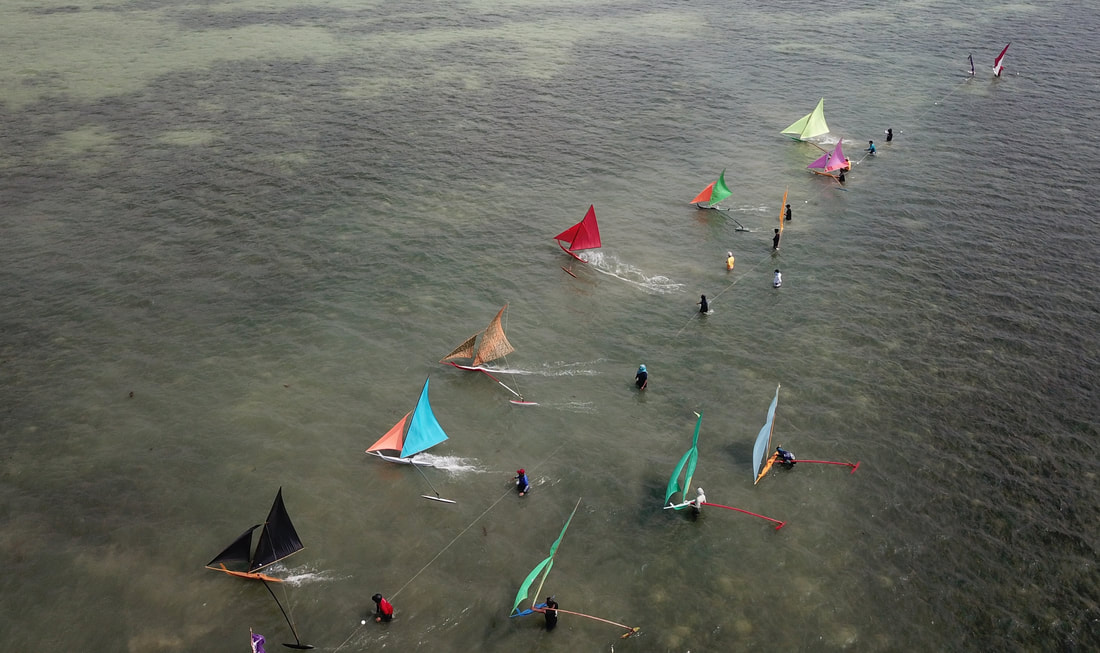
Two forces govern every race day at Teluk Bakau, and neither of them can be argued with: the wind, and the tide. Everything else — when we race, how wide the beach is, which boats can even float — gets decided by these two long before anyone picks up a jong.
THE WIND, AND WHERE THE RACES GET THEIR NAMES
Indonesia doesn't really have four seasons — it has two winds. The northeast monsoon blows from December through late March, arriving damp off the Indian Ocean and bringing the rains with it. The southwest monsoon arrives as early as June and holds through September, dry off the Australian continent, and the country dries out behind it.
Our two races are named after these winds, in the local way of naming a wind by the direction it's coming from: the Utara race sails under that northeast monsoon. The Selatan race sails under the southwest monsoon that follows it. So when someone asks why one race is called Utara and the other Selatan, the honest answer is: because that's which way the wind is blowing that season.
The wider compass has its own vocabulary too, much of it centuries old and borrowed from the same trade routes that first brought outrigger sailing to these waters:
Utara — North
Selatan — South
Timur — East
Barat — West
Timur Laut — Northeast
Tenggara — Southeast
Barat Daya — Southwest
Barat Laut — Northwest
A couple of these words carry real history. Utara comes from the Sanskrit úttara, meaning "higher up" — a reference to the Himalayas lying north of India. Tenggara comes from the Malayalam teṉkara, "southern coast." Both arrived in Malay through the same Indian Ocean trade that shaped this coastline long before anyone was racing jongs on it.
THE TIDE
If wind decides whether a jong can sail, tide decides where and when. Pasang is the rising water — air pasang, high tide. Surut is the falling water — air surut, low tide, when the sand widens and the seagrass bed dries out. Together, the whole cycle is called pasang surut, often shortened to pasut.
Twice a month, the tide swings hardest: pasang purnama, the spring tide, when the sun, moon, and earth line up at full and new moon and you get the highest highs and the lowest lows. In between sits pasang perbani, the neap tide, a gentler swing that comes around the moon's quarters.
Fishermen here have read pasut for generations — when to go out, when to come home, when the water will let a boat through and when it won't. We read it for a different reason: a low, wide, gentle tide is exactly what makes a beach good for racing, and even better for teaching. It widens the sand, keeps the water shallow and forgiving, and gives a beginner room to make mistakes without real consequence.
Some in the region still call the whole rhythm irama laut — the rhythm of the sea. It's not a bad way to think about it. The wind sets the season. The tide sets the day. And somewhere inside both of them, a jong finds its moment to sail.
Two forces govern every race day at Teluk Bakau, and neither of them can be argued with: the wind, and the tide. Everything else — when we race, how wide the beach is, which boats can even float — gets decided by these two long before anyone picks up a jong.
THE WIND, AND WHERE THE RACES GET THEIR NAMES
Indonesia doesn't really have four seasons — it has two winds. The northeast monsoon blows from December through late March, arriving damp off the Indian Ocean and bringing the rains with it. The southwest monsoon arrives as early as June and holds through September, dry off the Australian continent, and the country dries out behind it.
Our two races are named after these winds, in the local way of naming a wind by the direction it's coming from: the Utara race sails under that northeast monsoon. The Selatan race sails under the southwest monsoon that follows it. So when someone asks why one race is called Utara and the other Selatan, the honest answer is: because that's which way the wind is blowing that season.
The wider compass has its own vocabulary too, much of it centuries old and borrowed from the same trade routes that first brought outrigger sailing to these waters:
Utara — North
Selatan — South
Timur — East
Barat — West
Timur Laut — Northeast
Tenggara — Southeast
Barat Daya — Southwest
Barat Laut — Northwest
A couple of these words carry real history. Utara comes from the Sanskrit úttara, meaning "higher up" — a reference to the Himalayas lying north of India. Tenggara comes from the Malayalam teṉkara, "southern coast." Both arrived in Malay through the same Indian Ocean trade that shaped this coastline long before anyone was racing jongs on it.
THE TIDE
If wind decides whether a jong can sail, tide decides where and when. Pasang is the rising water — air pasang, high tide. Surut is the falling water — air surut, low tide, when the sand widens and the seagrass bed dries out. Together, the whole cycle is called pasang surut, often shortened to pasut.
Twice a month, the tide swings hardest: pasang purnama, the spring tide, when the sun, moon, and earth line up at full and new moon and you get the highest highs and the lowest lows. In between sits pasang perbani, the neap tide, a gentler swing that comes around the moon's quarters.
Fishermen here have read pasut for generations — when to go out, when to come home, when the water will let a boat through and when it won't. We read it for a different reason: a low, wide, gentle tide is exactly what makes a beach good for racing, and even better for teaching. It widens the sand, keeps the water shallow and forgiving, and gives a beginner room to make mistakes without real consequence.
Some in the region still call the whole rhythm irama laut — the rhythm of the sea. It's not a bad way to think about it. The wind sets the season. The tide sets the day. And somewhere inside both of them, a jong finds its moment to sail.