Selatan Season · August 2025
The rain that couldn’t stop it
Fourteen villages, 197 jongs, and a downpour that almost took the whole day down before a wrong-direction breeze and a beach full of tarps and tree trunks turned it back around.
Selatan Race · Teluk Bakau, Bintan
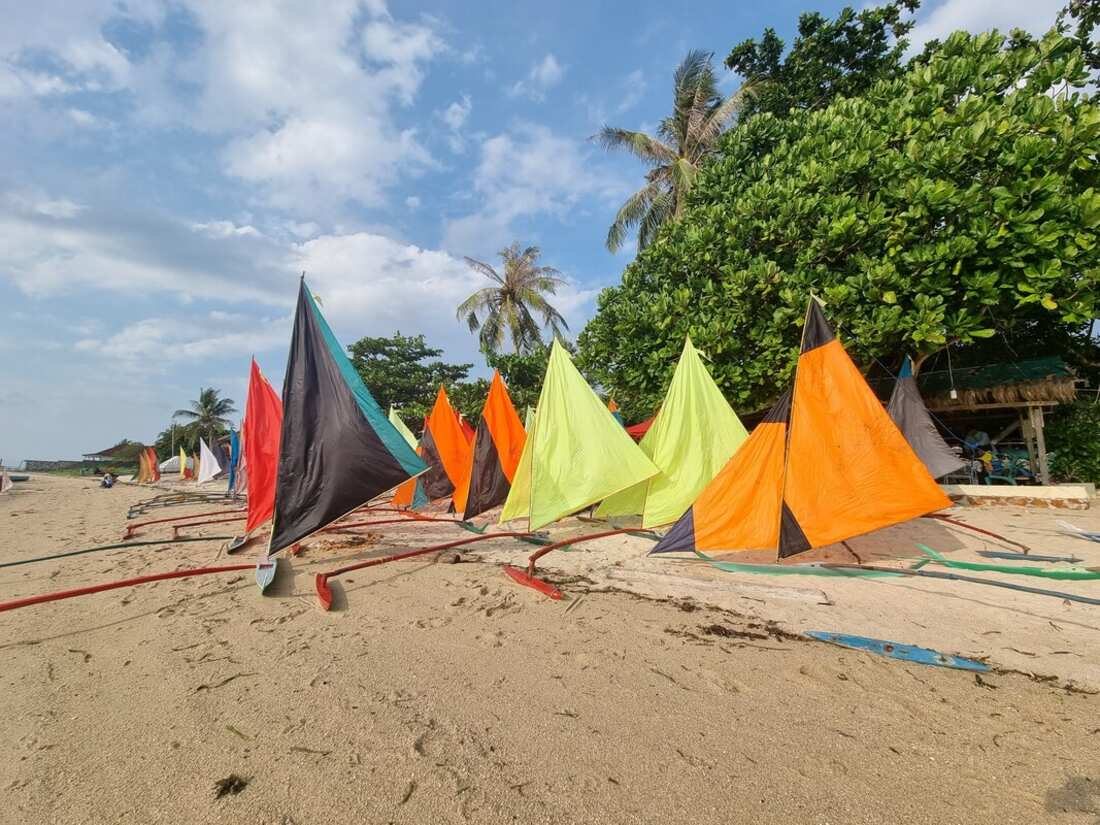
Rain isn’t supposed to fall like that during Selatan season. But it did, that morning — sudden, unseasonal, hard enough that for a moment it looked like it might take the whole day down with it. Fourteen villages had already brought their sails to the beach, each one carved and decorated by hand, ready and waiting. The crowd was already massive. And then the sky opened up.
What happened next is the kind of thing that’s hard to explain to someone who’s never seen gotong royong in motion. Nobody panicked. Nobody packed up and left. Villagers and visitors just started building — tarps stretched between the trunks of beachfront trees, whatever material was at hand turned into shelter. Within minutes there was a whole improvised village of canopies along the sand, people huddled together under them, passing around hot coffee and snacks from the bazaar stalls, waiting the rain out like it was just another part of the program.
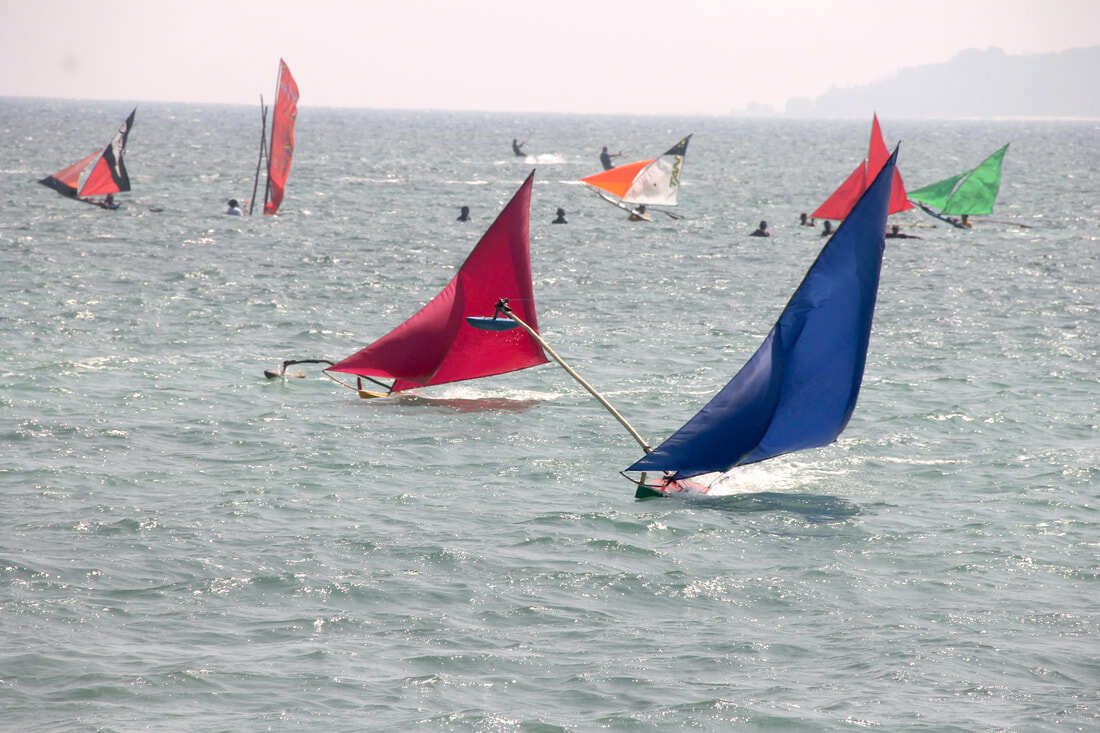
Around eleven, the sky finally let go, and a breeze came in behind it — light, but wrong. It was blowing from the northeast, which almost never happens in the middle of Selatan season, when the wind is supposed to hold steady from the south. For most people that would be a footnote. For sailors who’ve spent years reading wind and tide, it was an emergency and an opportunity in the same breath. Outriggers got swapped. Masts got adjusted. Lines were re-rigged on the spot, boat by boat, everyone recalculating in real time. It turned into as much a display of ingenuity as it was a race — proof that this has never really been only about speed.
The day opened properly with the Sekapur Sirih dance, and this year it carried something extra for me: my daughter was up there too, new to the performance, moving through it alongside dancers who’d done it for years. Then the racing began in earnest — 197 jongs launched over the course of the day, each one someone’s work, someone’s obsession, someone’s inheritance. The wind stayed light and northerly, which made for a genuinely tactical race, finalists reading every small shift in the breeze rather than just outrunning it. And the crowd watching them do it was its own kind of remarkable — local villagers standing next to tourists from the US, France, and Britain, visitors down from Jakarta and Yogyakarta, and the Orang Laut, come over from Lingga and Tanjung Pinang. Everyone cheering the same boats.
As the sun dropped, the day turned into something else entirely. Trophies and prize money changed hands, but that was almost beside the point by then — what stuck was the feeling of the whole community still standing there together, hours after the rain had threatened to end it all. The evening opened with an offering, a small ceremony giving thanks to the spirits of the ocean and the ancestors who’d sailed these waters long before any of us — a reminder of exactly how far back this all goes. Then the music took over: children from Teluk Bakau dancing, traditional Malay performers, a contemporary dance duo working somewhere between the old and the new. A well-known drummer came over from Singapore. Local bands played. Indonesian DJs closed it out. The rain that had opened the day never came back, as if whatever it was that watches over this beach had decided we’d been tested enough for one year.
“Something threatens to take the day down, and the day finds a way to hold anyway — not despite the people there, but because of them.”