Two forces govern every race day at Teluk Bakau, and neither can be argued with — the wind, and the tide. This year they held mostly true, and still found a way to surprise us.
A Story of the Selatan Race, Teluk Bakau · August 15, 2026
You never step in the same river twice.
A jong, if you’ve never seen one: a small wooden sailboat, carved by hand, no bigger than a child is tall — raced unmanned across shallow water, steered by nothing but the set of its sail and the skill of whoever built it.
Two things govern every race day here, and neither of them can be argued with: the wind, and the tide. Everything else — when we race, how wide the beach is, whether a boat sails true or breaks — gets decided by these two long before anyone picks up a jong. And yet no two years are ever quite the same river. The wind that carried last year’s race turned northerly halfway through, in the middle of what should have been steady Selatan season — a reminder that even a forecast checked on three different apps is really just a polite guess.
Indonesia doesn’t really have four seasons. It has two winds. The northeast monsoon blows from December through late March, damp off the Indian Ocean, and the rains come with it. The southwest monsoon arrives as early as June and holds through September, dry off the Australian continent, and the country dries out behind it. Our races are named the old way — after the direction the wind comes from that season. The Utara race sails under that northeast wind. The Selatan race sails under the southwest wind that follows.
Tide runs on its own clock, separate from the wind’s. Pasang is the water rising. Surut is the water falling, the sand widening, the seagrass bed drying into flats you can walk across. This year the tide was right, but the navigable window was narrow — ten in the morning to six at night — which shaped everything else about how the day had to run.
Tomorrow is the Selatan race.
That’s what I kept telling myself the evening before, watching it come together on the shore of Teluk Bakau. This year, for the first time, we really managed to fold the kids into the pre-race preparation itself — not a separate lesson off to the side, but the real thing, happening around them. The different kelompok gathered to set the next day’s lineup. Some had already unloaded their jongs and staked out their patch of beach, and without wasting time, they were out practicing the course, hunting for the particular angle the wind wanted, fine-tuning rigs against it. Twenty-three groups came this year — Batam, Penyengat, Dompak, Teluk Sebong, Tanjung Siambang, Teluk Bakau, and more from around Bintan and Tanjung Pinang.
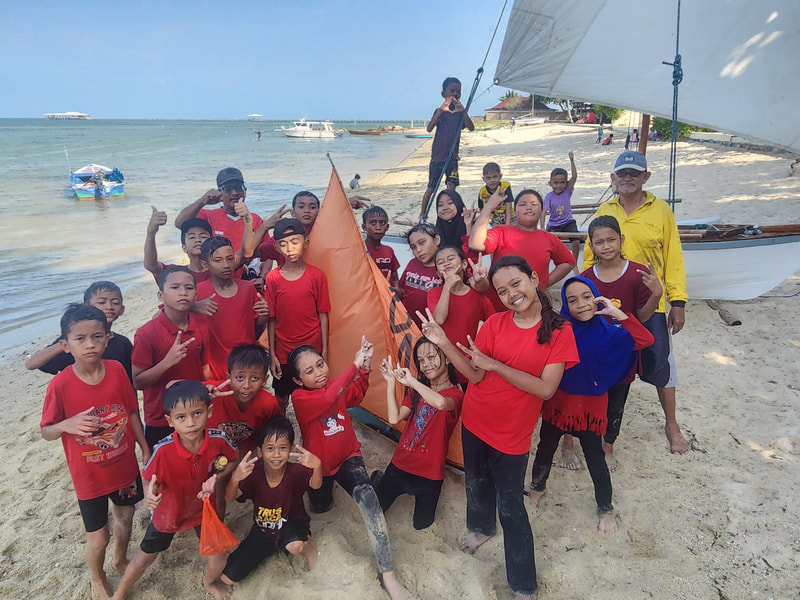
We had funding for twenty kids. We taught closer to twenty-five, once my own daughter and a few of her friends folded themselves into the group — nobody was going to turn them away. They watched the big adult jongs being readied nearby, watched the pickup trucks unloading hull after hull from each kelompok, before it was their turn to hold a small training jong into the wind for the first time.
The youth group, folded into the real pre-race preparation for the first time this year.
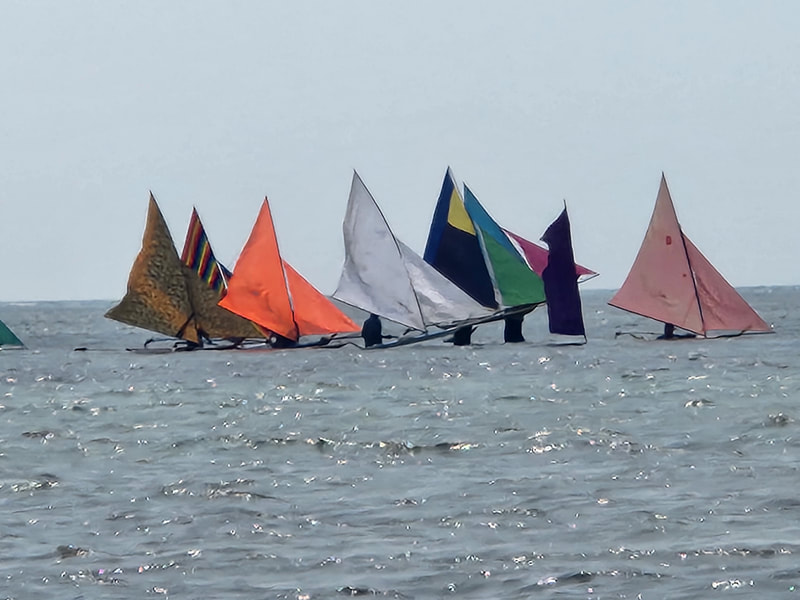
What struck me most, watching the grown boats come off those trucks, was how many new ones there were. Slightly bigger. A slightly greater ratio of mast to hull, built to carry a bit more canvas. New sails, cut clean. Everyone had brought their best boat this year — mine is old now, semi-retired, still sailing but not really competitive anymore. A new generation of real racers is coming up, and it shows. The new jongs themselves are leaner than the old ones — less decorated, a cleaner style taking hold. That’s evolution, I suppose, happening in real time on a beach in Bintan.
Every one of those hulls, old or new, started the same way: a piece of pulai wood, cut and left to dry for a month or two before anyone dares shape it. Rush that step and you’re already building a bad jong. Once cured, the hull is drawn out by hand and hollowed as thin as the wood allows without losing its strength — until what’s left is light enough to fly.
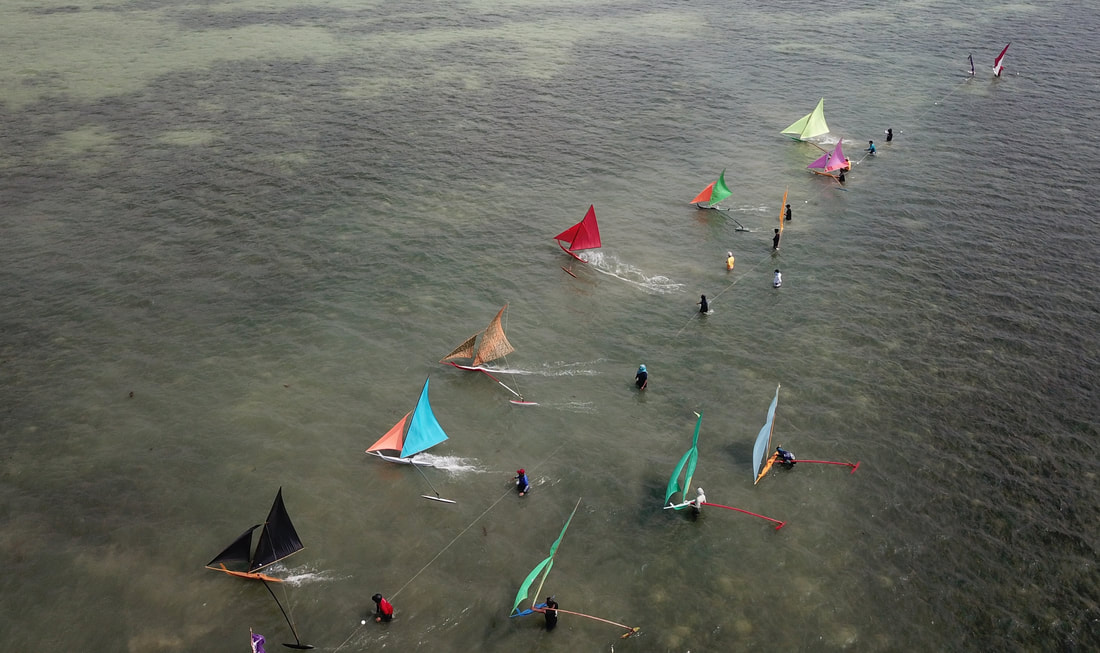
The wind held close to 10 to 14 knots through the day — fast, exciting, and genuinely beautiful. There are no cigarette banners here, no bank logos, none of the usual noise that sponsorship drags onto an event like this. We’ll take sponsors’ money gladly — it’s what keeps this running — but not at the cost of hurting the eye. The attention belongs on the art of the racing jong and the people sailing it, not on what’s printed behind them.
A steady 10 to 14 knots through the day — fast, exciting, and genuinely beautiful.
This year, after some searching for hands to sail them, two of my older jongs went out with new racers at the helm, and I loved watching them race regardless. Darts, who’s worked on Nikoi Island since building first started there, bought a jong of his own this year and raced it for the first time — he named it Nikoi Island, after the place and the sponsor both. Nikoi has backed us for years now and never once asked for a logo hung anywhere. That kind of sponsor is rarer than it should be.
The jury has changed almost as much as the boats. These days it runs on printed sheets, laptops, handheld radios relaying calls from the water to the starting line. In the earliest years, everything was done by hand — someone cutting little paper slips and writing each result out one at a time. Seen up close, it’s a strange and genuinely extraordinary lesson in how a small society organizes itself.
All the senses fill up on a day like this, including the ones that don’t show up in any official record — salt, color, the smell of algae drying on the sand, wind, water, the constant flap and snap of sails catching and losing the breeze all at once. The sails do the rest, letting each jong lift almost off the water, flying more than sailing.
“We’re not trying to keep any of it behind glass. We’re trying to keep it in people’s hands, one season, one tide, one kid at a time.”
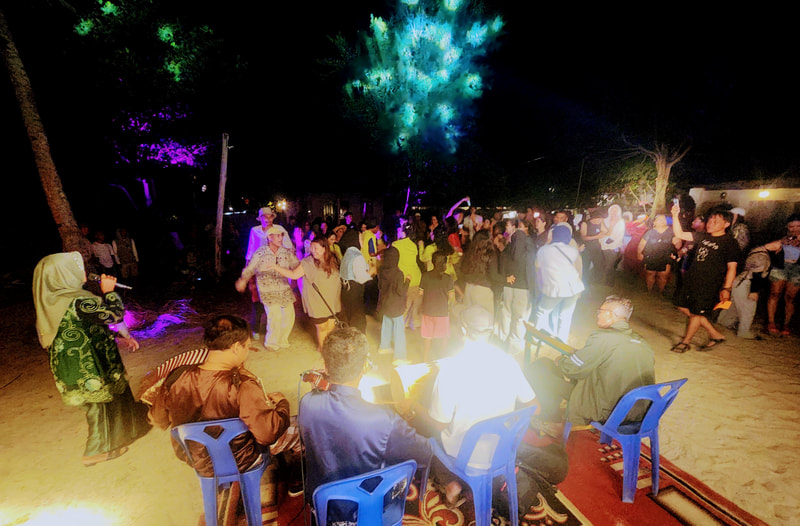
Schools came again this year too — some purely to watch, others to help. One team spent the morning cleaning the beach. Another looked after the visiting guests. We tried QR codes for the first time, a small piece of the modern world stitched into a very old one. That evening, the traditional dangkung played on the same sand as electro and avant-garde performance, one dissolving into the next without anyone treating it as strange. Among it, the kids’ group took the floor themselves, performing a choreographed dance led by Dwi — nearly two weeks of rehearsal behind it, building a small tale of wind and waves and sea, and of simply being together, which is really what the whole day is about underneath everything else.
Dangkung, electro, and the kids’ own choreographed dance, all on the same stretch of sand.
By evening, the fleet was back on the sand, salt-crusted, sails down. The same wind that carried the whole day would keep shifting with the season, and somewhere around March or April it would swing back around toward the north, and it would be time again to start thinking about the Utara race. The tide would rise and fall exactly the same the next morning, indifferent to who’d won.
None of this is really about nostalgia. It’s closer to a reminder: that this coastline has always been a maritime place, that wind and tide shaped how people here lived long before anyone wrote it down, and that a small wooden boat, raced by a kid on an August afternoon, is still part of that same story — a slightly different boat, a slightly different kid, the same river never stepped in twice. We’re not trying to keep any of it behind glass. We’re trying to keep it in people’s hands, one season, one tide, one kid at a time.
Let’s keep this going. — Michel Lippitsch, The Jong School — Teluk Bakau, Bintan Island