PASSING IT ON
Notes from a kids' session, the day before the Selatan race
While the jury gathered to welcome one representative from every group racing the next day — to draw the racing order, to go over the rules once more — the beach was already filling with a different kind of energy. Groups, called kelompok, were arriving by the truckload, jongs stacked and tied down, sails still furled.
I'd set a limit this year: ten jongs per group. It keeps a race finishable in a single day, and lets us host more groups rather than fewer boats each. This year brought twenty-three of them, from all across the island — as far as Batam, as far as Pulau Penyengat. Penyengat would go on to sweep all three prizes in the big jong category, though none of us knew that yet.
Players were already out tuning their boats. The wind was blowing at 12 knots, gusting to 15 — enough to test even the older jongs. Something always breaks on a day like this. Today was no exception.
And that's exactly the kind of day to have kids watching. Not a quiet demonstration, but the real thing — wind, wood, and boats that sometimes fail — so they can see firsthand what it actually takes.
WHY THIS MATTERS
We started these sessions almost by accident, whenever funding came through friends or organizations willing to back them. They've found real traction with international schools, which is genuinely good — but the local kids need this too, maybe more. This tradition sits closer to their own identity than to anyone visiting it. Jong racing belongs to a wider Malay maritime world — carried, among others, by the Orang Suku Laut, the sea nomads of this archipelago, but not theirs alone; it's a shared inheritance across these islands' fishing and seafaring communities. For local kids, learning to sail a jong isn't just picking up a skill; it's picking up a thread that runs back through their own history.
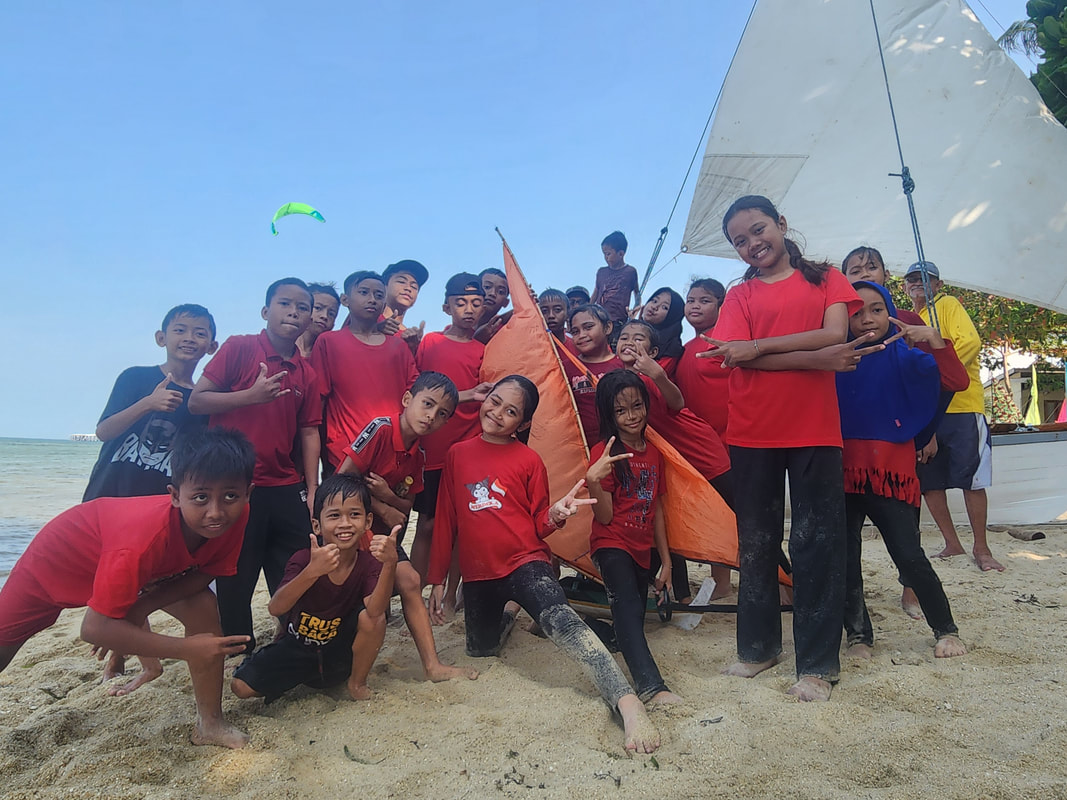
The dream would be to make this part of every Bintan child's education — a real curriculum, not a favor dependent on whoever happens to be funding it that month. We're a long way from that. For now, we run sessions of twenty kids whenever a sponsor makes one possible. This time, it was The Residence Bintan that came through.
READING THE TIDE
Tides set the tempo here, as much as wind does. The Selatan wind turns out to be close to ideal for teaching kids: it widens the beach as the tide drops, keeps the water shallow and forgiving, and holds steady around 15 knots — enough to move a jong, not enough to punish a beginner's mistakes.
Thanks to Dui — who, on top of everything else, is a serious dance choreographer — we pulled together a group of kids from the neighborhood, and from as far as Kawal, to make this particular session happen.
My Bahasa still isn't perfect, but I taught my first class in it anyway. Hendra, an English teacher visiting from Tanjung Pinang, sat in to see where a collaboration might be possible down the line.
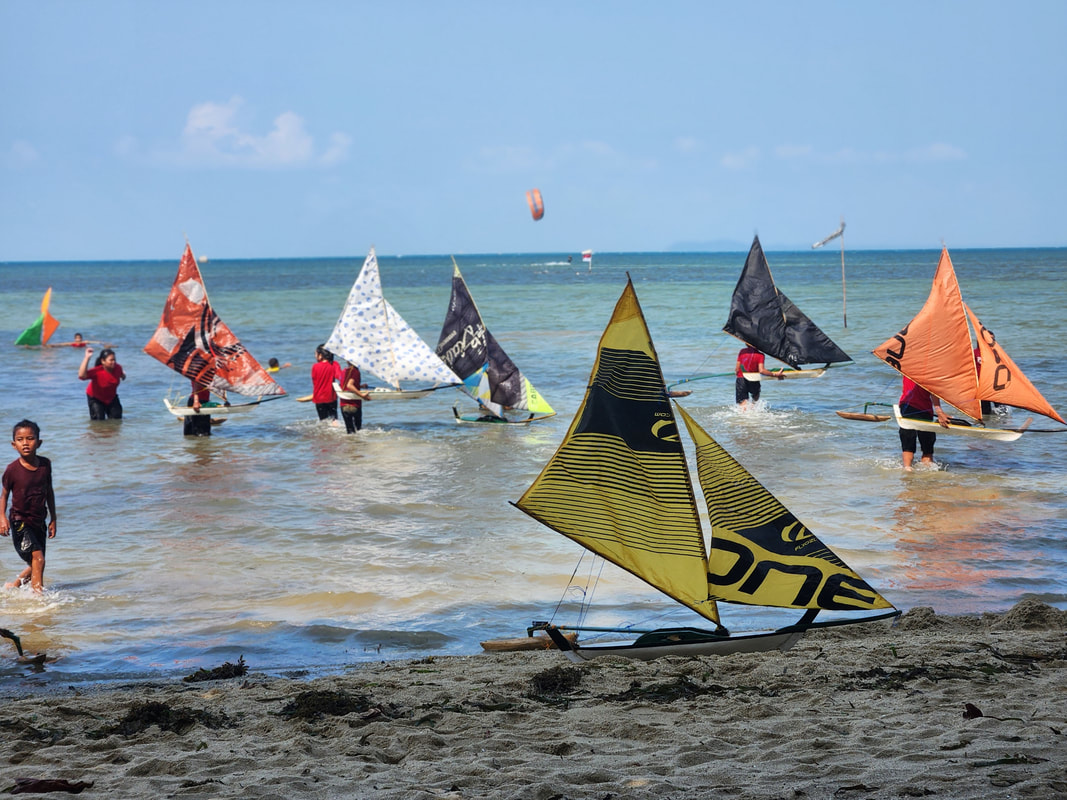
Ibrahim had the training jongs already set up, juggling that with getting the big racing jongs ready for the next day. Between the two jobs, the beach filled with the particular kind of noise that only kids and boats make together.
LEARNING BY DOING
We started with the basics: reading wind direction, learning to hold a jong steady into the wind. Then each pair of kids named their jong — a small ceremony that matters more than it looks — and the racing began.
Assim, who would take second place in the medium-jong race the following day, stopped to give tips to the youngest ones. Zaki joined too — twelve years old, sailing jongs since he was seven or eight, old enough now to translate the vocabulary of jong-building for the others: which part is which, what each knot is for.
By the end, the kids had organized their own races without anyone asking them to. Nobody wanted to stop.
That, more than anything I could have planned, is the whole point. Learning by doing — and not wanting to put the boat down when the lesson's over.
Notes from a kids' session, the day before the Selatan race
While the jury gathered to welcome one representative from every group racing the next day — to draw the racing order, to go over the rules once more — the beach was already filling with a different kind of energy. Groups, called kelompok, were arriving by the truckload, jongs stacked and tied down, sails still furled.
I'd set a limit this year: ten jongs per group. It keeps a race finishable in a single day, and lets us host more groups rather than fewer boats each. This year brought twenty-three of them, from all across the island — as far as Batam, as far as Pulau Penyengat. Penyengat would go on to sweep all three prizes in the big jong category, though none of us knew that yet.
Players were already out tuning their boats. The wind was blowing at 12 knots, gusting to 15 — enough to test even the older jongs. Something always breaks on a day like this. Today was no exception.
And that's exactly the kind of day to have kids watching. Not a quiet demonstration, but the real thing — wind, wood, and boats that sometimes fail — so they can see firsthand what it actually takes.
WHY THIS MATTERS
We started these sessions almost by accident, whenever funding came through friends or organizations willing to back them. They've found real traction with international schools, which is genuinely good — but the local kids need this too, maybe more. This tradition sits closer to their own identity than to anyone visiting it. Jong racing belongs to a wider Malay maritime world — carried, among others, by the Orang Suku Laut, the sea nomads of this archipelago, but not theirs alone; it's a shared inheritance across these islands' fishing and seafaring communities. For local kids, learning to sail a jong isn't just picking up a skill; it's picking up a thread that runs back through their own history.
The dream would be to make this part of every Bintan child's education — a real curriculum, not a favor dependent on whoever happens to be funding it that month. We're a long way from that. For now, we run sessions of twenty kids whenever a sponsor makes one possible. This time, it was The Residence Bintan that came through.
READING THE TIDE
Tides set the tempo here, as much as wind does. The Selatan wind turns out to be close to ideal for teaching kids: it widens the beach as the tide drops, keeps the water shallow and forgiving, and holds steady around 15 knots — enough to move a jong, not enough to punish a beginner's mistakes.
Thanks to Dui — who, on top of everything else, is a serious dance choreographer — we pulled together a group of kids from the neighborhood, and from as far as Kawal, to make this particular session happen.
My Bahasa still isn't perfect, but I taught my first class in it anyway. Hendra, an English teacher visiting from Tanjung Pinang, sat in to see where a collaboration might be possible down the line.
Ibrahim had the training jongs already set up, juggling that with getting the big racing jongs ready for the next day. Between the two jobs, the beach filled with the particular kind of noise that only kids and boats make together.
LEARNING BY DOING
We started with the basics: reading wind direction, learning to hold a jong steady into the wind. Then each pair of kids named their jong — a small ceremony that matters more than it looks — and the racing began.
Assim, who would take second place in the medium-jong race the following day, stopped to give tips to the youngest ones. Zaki joined too — twelve years old, sailing jongs since he was seven or eight, old enough now to translate the vocabulary of jong-building for the others: which part is which, what each knot is for.
By the end, the kids had organized their own races without anyone asking them to. Nobody wanted to stop.
That, more than anything I could have planned, is the whole point. Learning by doing — and not wanting to put the boat down when the lesson's over.