The Selatan Race 2026 at the Jong School in Teluk Bakau
For those who don’t yet know what a jong is: it’s a small wooden sailboat, hand-carved, rarely longer than an arm, raced across open water powered by nothing but wind and the skill of the person who shaped it. No engine, no remote control — just wood, cloth, and a deep, intuitive read of how the air moves across the water. Jong racing belongs to a wider Malay maritime world, carried among others by the Orang Suku Laut, the sea nomads of this archipelago — a shared inheritance across these islands’ fishing and seafaring communities.
The evening before the race, the beach at Teluk Bakau was already alive. Local kids were there, learning and eating, running between the tables and the boats, while the different groups — kelompok — quietly organized the next morning’s heats. Twenty-three groups arrived this year, from all across the island and as far as Batam and Pulau Penyengat. Penyengat would go on to sweep all three prizes in the big jong category.
This year brought exceptional winds, an exceptional crowd, and an exceptional spirit. The dancing moved from old local dangkung to avant-garde performance from Taktido — a collective we’ve worked with since a first, short-notice show that came together on almost no sleep at all (their name comes from tidak tidur, “no sleep,” which is exactly how it felt, and exactly why it worked). From there the evening moved into Malay music, including a piece choreographed and danced by kids on the theme of the jong itself, and finally a DJ set that got the younger crowd moving.
It takes many hands to make a day like this happen. A place has to be made available, welcoming. Trees to carve the jong. Masters to build them. Others to sail them. Sails are sewn, wood is bent, knots and mast tension and proportions are all judged by feel — and somehow, no two jongs are ever the same.
It takes a group to coordinate transport and logistics — and it takes wives and grandparents preparing food, so much time and care that it remains genuinely humbling, every year.
This tradition is quietly becoming something people travel for — clubs from Singapore and Batam, anthropologists, visiting schools — and watching it travel outward, sometimes out of our hands entirely, takes some getting used to. But the growing interest, wherever it lands, is the real success. The tradition surviving and spreading matters more than who gets credit for it.
Thank you to everyone who sailed, danced, cooked, judged, and showed up — this only exists because so many people choose, quietly, to make it happen. Let’s keep this going.
— Michel Lippitsch, The Jong School
Ready to open — a jong at Teluk Bakau, sail cut and rigged by hand.
“You need to get married with your Jong,” says Zakir, late one night sipping coffee on the beach. I first met Zakir on New Year’s Day, sailing his Jongs with a few friends. The beach was full of kids playing, and the sails attracted me like a magnet. I love sailing—not just the boats themselves, but the entire spirit that moves people to go and be with the elements and brave the sea.
The Jongs are “sexy” boats, using seductive methods to “catch” you. In the Western sailing world, boats are always referred to as she. At first, you start flirting, watching them from afar, inspecting them curiously. You strike up a conversation with the owner and get a glimpse of the Jong’s name and personality.
Eventually, I got married, too. I bought two Jongs during a racing event in Teluk Sebong from the Jong makers of Bengkalis in Eastern Sumatra. Zakir, acting as my matchmaker, chose the Jongs—my “wives.” We renamed the boats. He chose Bule Kampong (literally, “the white man from the village”), and I chose Planet Samudra (ocean planet), but we cut to the chase, and she became simply Planet.
The tradition of the Jong predates the arrival of Islam, deeply rooted in the animist world of spirits. Originally designed to send out gifts of betel nut and other sacred foods to sea, the Jongs evolved into real sailing art pieces. Although they are unmanned boats, many secrets guard the “jong.” Each builder finds new ways to improve the design, but the fundamental design itself stays the same, rooted in geometry and symmetry based on the human body.
I spent many nights with Zakir and his family, but also alone, speculating on the mystery that surrounds the world of Jongs. It was a dream-like state, a chance to reinvent their possible history.
They are intimately connected to the Orang Suku Laut, the original nomadic tribe that controlled the sea around Riau. They became the navy of the Malays but also cultural players in the courts of the Malay aristocracy. Many groups of Orang Laut are now intermixed and more sedentary, some are downright outcasts, but a spirit of freedom prevails. The Malays themselves are scared of the power of the Orang Laut magic. And you truly need magic to sail a Jong. “You need to keep your heart clean.”
The First Race: A Community Endeavor
We decided to organize a first race in Teluk Bakau during the Northwest Monsoon last March. The first event in Teluk Bakau in early March 2013 proved that the locals could rise to the challenge and take care of the logistics for a complex new endeavor. This came with a lot of “Gotong Royong,” meaning people doing things to help the community and each other. Although the original plan was to have a much smaller event, the attendance grew, and we ended up with four villages competing, with a rarely performed interactive dance in the evening to celebrate the achievement.
“When is the next one?” was a question that often popped up during casual conversation. Not wanting to be a one-off event but a program with a long-term vision, we started to think about our next race. In the spirit of being holistic, the seasons gave us our tempo: one race for the “utara,” or northwest wind, and a “selatan” race for the southeasterly winds.
Meanwhile, we built a pondok at Zakir’s house. Wood was chosen and distributed, and about 10 new Jongs were born, at least half of them competing in the “selatan” race. The pondok is made entirely of local materials and is the builder’s place, where anyone can visit and see Jongs being made firsthand. A second builder also lives in Teluk Bakau, and with my small fleet of two Jongs, we form the core group of Jong owners. The Jong owners upkeep and maintain the boats, keeping them alive. Other players help launch the boats; one can be assigned a Jong to be tested and tuned, so many people actually learn the art. But few bother to own Jongs. Everyone loves to see and play with them.
It’s also the place where Jongs are decorated to participate in provincial events—a first last time, where two floats were built around two bikes and paraded among schools, dancers, musicians, and so on, to truly give the Jongs their due place in Malay culture. One Jong, Bule Kampong, was on display at the Bintan stand for the national day of the Indonesian Boy Scouts, and we even sneaked in a few coral reef pictures there to activate curiosity and wonder.
Building the Tradition
With the Jong and sampan dockyard in place, it was time to think about building the traditional yacht club. It’s a big name for a few tables under a tree and an old recycled fishing boat with cushions. A pondok is also in place that is freely used by the local fishermen, and a full kitchen and bar are in the making. This is a gateway to the sea in a coast that is increasingly getting developed and fenced off. Instead, we did the opposite. We built an access road and opened up the area. We also bought a traditional sailboat, and a guest visiting Nikoi mailed us some old sails (by his standard). We are in the process of recutting a sail once the rudder is finally completed. Good wood is hard to find on Bintan, and most decent pieces need to be found on the islands.
The boat is part of an Indonesian group called KELOMPOK JONG “SEKAPUR SIRIH.” We are bringing together the different Jong owners and players around Bintan to have the villages represented rather than always the capital, Tanjung Pinang. In the locals’ eyes, the city of Tanjung Pinang is a different entity, separate from Bintan itself.
A week before the upcoming race, Jongs were tested every day when the tide was right. At the same time, the spirit of “Gotong Royong” strengthened, helping clean the beach and setting up benches. For the trash, usually a huge challenge, we put 30 recycled rice bags on some bamboo poles and cut some ashtrays out of aluminum cans. It won’t entirely solve the problem, but it is an experiment to change consciousness toward waste. The cans were automatically recycled simply because they have a cash value. Kids are watching the Jongs get tested, and a few will become Jong sailors. Usually, a few men, the Jong masters, have a fleet at their houses with different sails and hulls to give them an edge during the race. One Jong will perform well in high winds; another is more suited for lighter winds.
In the evenings, the organizational side was discussed. Zakir spearheaded the actual race, setting and testing the course, ordering the poles, and getting the jury. A boat was lent to keep the starting jury in the shade and dry. With a few rules in place, Zakir went around Bintan on his bike to contact his friends and network to get them to attend the race, making a lot of phone calls. Another person prepared the invitations to be delivered, and so on.
The night before the event, a few Jongs were “opened,” with all their sails out. They would not go to sleep until the race was over. I hosted the party, with three live chickens left over from the Ramadan closing off Idul Fitri (I was actually on Nikoi that night rescuing a stranded yacht on the reef). We cooked it in our new wood-fired “pizza” oven and had a few drinks and music. But mainly, I watched closely as the last details were done on the Jongs. I learned to secure my anak (literally, “child”—the outrigger float), making sure the wedges are solid in place. I also know that quite a few details were kept secret, like someone taking a small handful of raw rice, some spells, no doubt, but also a form of concentration. Remembering that you cannot race with a heart that is not clean.
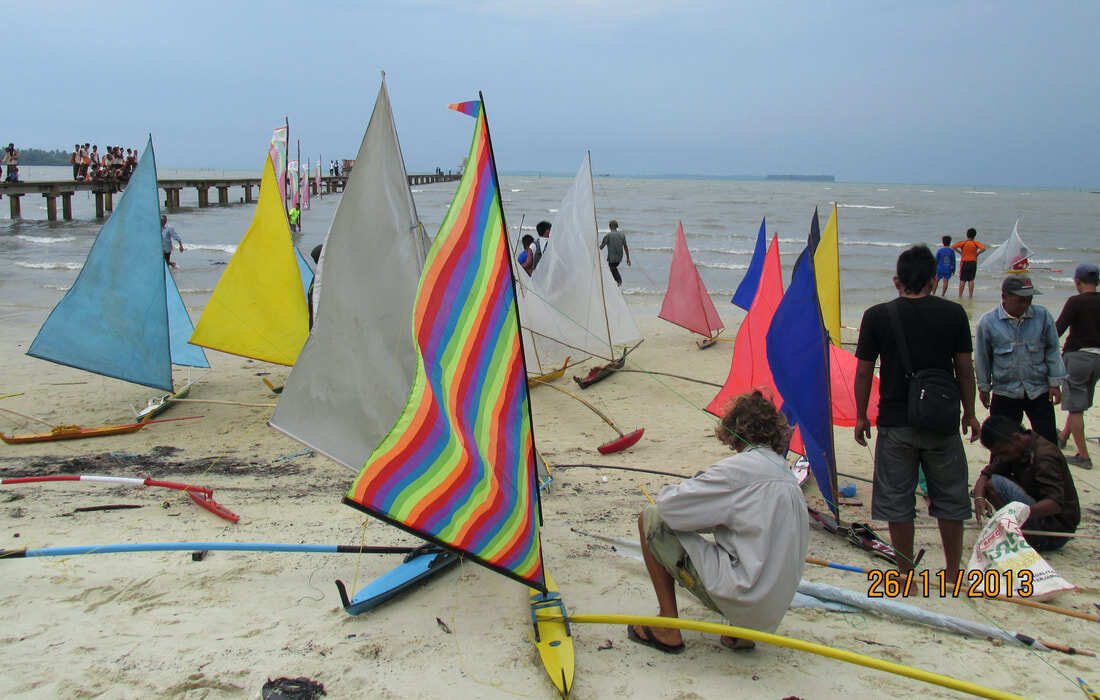
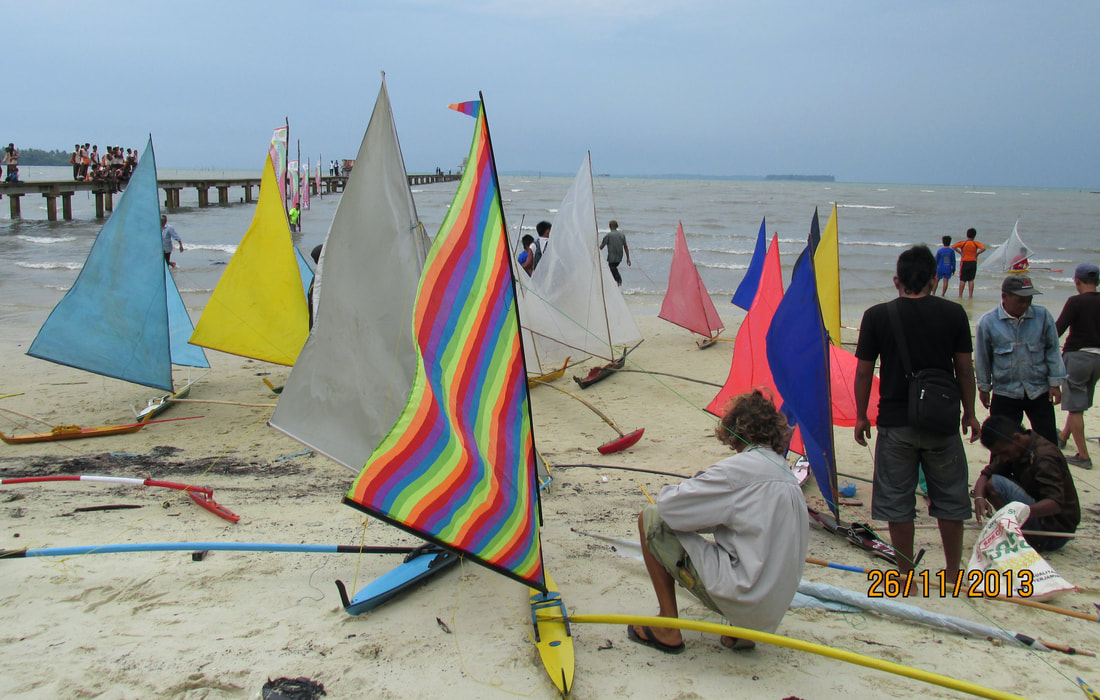
Dompak, November 2013 — the fleet, open and waiting, not long after that first Teluk Bakau race.
The Race Day
By 6 a.m., “the crew” is up and running. Poles are fixed in place, a last beach cleanup is done, chairs are coming, and food is arriving. By 7 a.m., the first Jongs are coming, some by car from a few hours away, some by bike, and some by foot. Six villages are participating, a few are setting up their small shops of snacks, and we provided drinks to the players. The elder who will open the ceremony is making the opening prayer, and a few local heads of the different areas are coming to show their support.
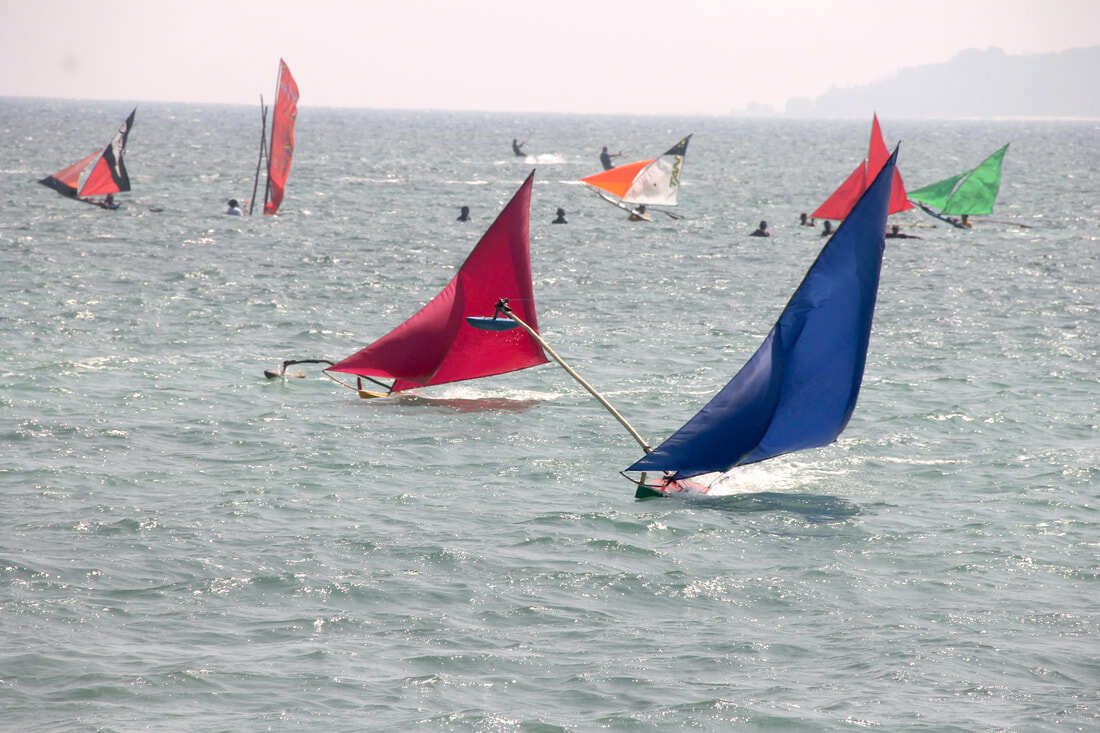
The beach is now full of spread-out Jongs, a beautiful rainbow of colors. Each village has been assigned an area with a pondok to keep their belongings and coffee served. But the most important element is here and not shy: the wind. Blowing in gusts of 15 knots, everyone knows there will be a few casualties during the race. The tide starts rising, fast.
The tender boat is going into position, and each Jong is assigned a number that will determine its position on the starting line. This is picked from a box so no one can “cheat.” (Some positions actually give you a slight lead.)
Then, “Mati Lampu” (power cuts). This actually happens daily around here, so neither the stereo nor the microphone can be used, and voices are slightly rising to be heard. The first players are getting into position, and the crowd is now getting excited with shouts and screams. Our official DJ decides to take his position on the tender, blowing the whistle.
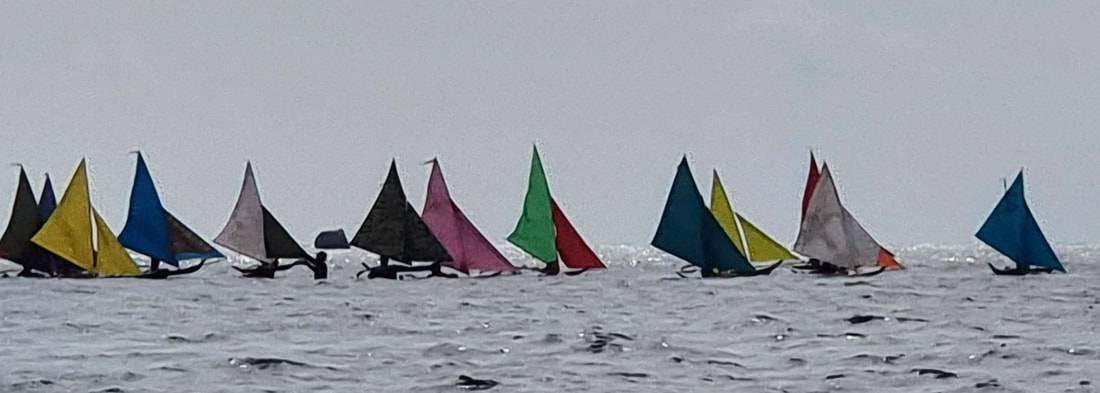
The MC needs to walk around a lot, setting the tempo for the players to be ready. And the tempo cannot slack off. Over a hundred Jongs are now open on the beach, and more than 80 will need to race the preliminaries to get into the finals. The finish line is set, and the first set of Jongs is going out to sea. The race is tricky; this is the first “selatan” race held, and it took the Teluk Bakau team a few days to figure out how to tune the Jongs. So we definitely have a winning edge there.
“27.” This is me. So I pick up my Jong. I didn’t do any readjustments apart from tightening the outrigger and start walking toward the starting line. I take a little GoPro camera with me to catch a bit of the action, but my concentration is on giving Bule Kampung a chance. The wind is blowing 14 knots but is slightly gusty. I am there on the starting line with ten other boats, waiting for the signal. Each number is called out. “Ready?” “Ready!” “Satu, Dua, Tiga” together with the whistle. The wind is strong, and the only thing I hear is the whistle, so I have a few seconds’ delay in my start. From there, you watch your “horse,” and you will know the result from a hand signal from one of your teammates. The walk back to the beach is serene; I made it to third place, enough to enter the finals. This is my personal account, but 100 people will follow these same steps today.
Time for my second Jong, “Planet,” to race. I walk to the line, a struggle. The boat is bigger, and any lapse of attention sends the boat off course. This one is a truly “wild horse.” I do a quick adjustment on my lesting and “Satu, Dua, Tiga!” Here she goes, deviating and colliding with another boat, actually a friend we nickname Kacamata (glass eye) because he wears thick eyeglasses. But somehow, the two Jongs are slowly going, and the faster boat missed the finish line and came off the “goal.” So the two boats, limping, almost cross the line but make it to the finals as well. By this stage, luck has entered the stage to become a serious player to be reckoned with.
The entire bus of students from the maritime university is busy taking pictures and mingling around. In fact, they made a program here to set up an experiment on the effect of bauxite on seagrass growth. Today is playtime. The Jongs that didn’t make the finals are dismantled quickly to leave the scene bright and clean for the finalists.
After a few casualties—a couple of Jongs broke on some rocks by being too far off course—we shorten the lunch break and start the final. Zakir’s boat is on the line, one from Kacamata, one from Berakit, one from Busung, Malang Rapat, and I choose to open Planet, while I need someone else to launch Bule Kampong. “Satu, Dua, Tiga. GO.”
Bule Kampong takes the lead. Zakir’s boat follows very closely, and Planet decides to ram another boat. So she struggles a bit. Bule Kampong, before the finish line, decides to let Zakir’s boat take her over in an inexplicable sudden stop, only to keep racing to finish second. Planet’s pride, after getting rid of the boat it just rammed, decides that she wants to be on the podium and makes an unbelievable finishing sprint to finish third. (She is a completely wild boat, I guess more interested in creating a bit of trouble but probably the fastest boat. I will need to learn how to tame her a bit.) I couldn’t believe it myself, and luck walked by my side.
The walk toward the beach now is almost shy, but the spirit of racing took all inhibition about feeling shy about trying to win. I was getting “panas” (hot in Indonesian). The crowd was cheering and a lot of thumbs up. Teluk Bakau, and our Jong group, held down their turf quite well. The final for the small race then starts, and the Mangrove Snake from Malang Rapat wins heads-up. Zakir’s boat takes second place.
After discussion, we decided to also award a fourth prize, called saguhati, whatever the heart feels like giving. The prizes are:
Big Jong — over 1.3 metres
1st prizeRp 1,000,000
2nd prizeRp 800,000
3rd prizeRp 600,000
SaguhatiRp 250,000
Small Jong — under 1.3 metres
1st prizeRp 800,000
2nd prizeRp 700,000
3rd prizeRp 500,000
SaguhatiRp 150,000
Total Jong prizesRp 4,800,000
In a few days, we will hold the prize-giving ceremony, timing it with other events like volleyball and so forth in a big karaoke night. I better learn a good song quickly. I will give my winnings to the Jong group, KELOMPOK JONG “SEKAPUR SIRIH,” which will allow us to get a few more tools and pitch in when the northeasterly winds start blowing in December, to visit the birthplace of “Bule Kampong” and “Planet” and race them there.
The race brings people together—old, young, man, woman—there is no boundary. But maybe the most important aspect is the fact that kids are now taking an interest. It is a tradition to feel proud of, cherish, and grow for the future. It is a competition about a clean game, and it is as green as it can get, with no carbon footprint. It is an art of precision, attention, and true values, a game of technique and our planet, and a vehicle to share and present ideas.
Some thank yous: to Nikoi for helping to sponsor the event in two ways, in money and time; to Peter, Terry, and Todd (Fishhead); to Planet Samudra for the media work; to all the players who gave their time and energy, in cutting grass, cleaning the beach, and so forth; to my landlord for the use of his land and for being active in trimming trees; to Amie for handling me through long nights of insomnia with always a smile and never refusing to make me a coffee; and to many more who entered my life at some point, whose energy and inspiration are surely in this program; and, of course, to Zakir, simply because without him it just wouldn’t happen.
Michel, in conversation, on the Kolek Sauh hull, the Orang Suku Laut, and what it actually takes to sail one
Why, after having spent half your life around the globe, being privileged to witness some of the grandest shows left on our planet, do you get so enthusiastic about some little fragile miniature sailing boats, the Jongs?
Because they are true masterpieces. Each single Jong carries its own individuality. It is true that I have searched around the globe for cultural manifestations from various tribal and “modern” societies to learn about what it means to be human. Although I do take my body for granted, I do not take neither my mind nor my heart as such. Both require work, a lot of work. The world of Jongs is a school, and I am one of its students.
Can you explain what you mean by it is a school? A sailing school?
There is so much more than meets the eyes. Buckminster Fuller had a great say: 99% of who you are is invisible and untouchable.
But that is true for everything really. So why specifically the Jongs?
The work that goes into the “game.” The design is of the highest sophistication, the ultimate simplicity. At the same time it relies on ancient knowledge passed on through the generations. No one knows how far back, and you can really get deeper into it. The dimensions are based on the human body, and rooted in animist beliefs where spirits are everywhere, including in your Jong, and every player has a few secrets of his own. It really is a detective story, and as such you try to collect as many viewpoints as possible to create the sharpest image. And the difficulty arises in the fact that everyone wants it blurred — by cultural design.
Can you elaborate on that point?
Well, there is the physical object, and this can be traced back to the local sail boat known as the Kolek Sauh. Identical shape and form of the hull, the racing rig that is found around the northern part of the Riau archipelago, from Johor, Singapore, Sumatra, and the islands near Batam and Bintan. I was told that it used to be the vessel that transported food to the spirit of the sea, in forms of betel nut, betel leaves, grain of rice and so forth. Those rituals can still be seen, not performed in public but definitely part of the tradition before the races.
In the Malay tradition there are two types of information: the one that can be readily shared and the one that needs to stay secret. Like in many tribal societies, your real name is actually never spoken. Many players really believe that they are playing with the help of their ancestors, called in with special mantras and so on. It is also highly competitive. Since it has taken the model of a race, there is a winner, and the players come to test their work against others.
There are metaphysical dimensions to the game, and this is not just theory — the Jong, as an extension of yourself, provides feedback to the effect of your focused attention. You can trace some of these exercises to the Sufi tradition that was, and still is, strong in various communities in the Riau Archipelago, especially the Naqshbandiyya order that came early to the east coast of Sumatra.
The tradition of “seamanship” in Asian cultures has shifted drastically through the years, especially in Riau. This is a big subject that could occupy a few researchers for a lifetime. To take a basic example: a tribal group named the Orang Suku Laut, “people of the sea,” used to control the ocean around Riau, advisers to the Malay sultanate, and are now relegated to sedentary lifestyles in portions of land that no investors wanted. The aristocracy of the Malays looks down on the people making a living from the sea, as “lesser” Malays. The provincial government rarely features the sea, usually a source of exploitation, especially among the Chinese community amassing fortunes from sea products.
You also have to remember that less than a hundred years ago, the sea and ocean around the world was full of sails, and the Riau Archipelago was one of the world’s pivots for trade between east and west — essentially everyone passed by here. So effectively, apart from a few traditional sailing boats used during a couple of races funded by the provincial government and a couple of small fishing canoes or small sampan, the art of traditional sailing has pretty much disappeared. Somehow the Jongs survived all this — partly because you do not have to have a lot of resources. The essence is time and skill, and without time there is no possibility of furthering one’s skill.
What does it take to make and sail a Jong?
A lot. Time — time to select the tree, the right time to cut it, the time to dry the wood before you can even begin to shape it. It takes passion, patience, dexterity, precision, geometrical knowledge, and so forth. You had to learn, either from watching and playing but especially by being taught. The measurement is based on the human body, and geometry where dimensions are half, a third, and so forth, without the need of any tape measure for example. My friend Zakir was showing me the dimensions by holding the Jong he chose for me between my arms, listening to the Jong, to the hole that steps the mast, fitting perfectly. Everything needs to be balanced, and trials are necessary to cut the sails properly. Lightness of the hull is key, but the most underrated element is the outrigger and its float, called the Anak, “the child.”
Are women playing as well?
I haven’t seen any, but there is no taboo against it. I think it is part of the culture to have different activities for the different genders, and like in the West boys play with cars while girls play with dolls. I have seen Zakir’s daughter try, but when it comes to racing they do shy away. She probably will race on the new addition to our yearly races, a children’s race. Usually it is older men and young adults participating in the races. The family comes to support, and in the case of serious players bringing a dozen jongs, you need help in the organization, transport, and actual launching of the jongs.
The prizes for the races can be quite substantial for a whole province race, at least by local standards — up to three salaries for the 1st prize. The last provincial race had the winner of the big jong class take 6 million rupiah (US$600).
How did you get involved?
One afternoon on New Year’s Day I saw a group of people playing close to my house. The sails attracted me like a magnet. I met Zakir that day, and it started the whole thing. We decided to organize a race in Teluk Bakau. I got funding from Nikoi Island and the island foundation to kick start it. From there we decided to organize two races a year, to keep with the natural monsoonal circle, and named the two races: Utara for the Northeast season, and Selatan for the Southwest season.
How does the race work?
It is divided into classes according to size. Usually ten jongs will race at one time and three of them will enter the following round, and so forth, until the last ten or twelve reach the grand final for the given class. There are rules, but basically you Buka (“open”) your jong on a starting line, and there is a finishing line between two posts, the goal. The fastest wins, but it needs to cross the line between the posts — I have seen a fast boat miss by a couple of millimeters. The players are tuning their jong according to the wind strength and direction; I personally carry lead weights to lest my Anak, the outrigger float, if the wind increases, for example. Everyone looks at everyone and will pick up tricks and learn.
During a very low-wind situation I rigged and tuned my jong differently than anyone else. It wasn’t fast but entered the “goal” and took first place of that preliminary race. On the next one, some players paid attention and adjusted their tuning. It was a one-off unusual situation, and I was lucky from my past experience trying to move a boat with a puff of wind, often stuck in the middle of the ocean. I am learning from these masters every time I participate. You have to remember that I am only a “child” in this scene.
Who makes jongs in your area?
There are really two makers, and two different styles as well. Both are in a bit of competition, and we are ending up right now with two groups. Wood is not easy to find anymore — so much land has been cleared. So the builders are always on the lookout, and keep their ears and eyes open. Zakir, for example, probably knows every suitable tree on the entire coast. So when he heard that some land was getting cleared, he negotiated with the contractor to secure the wood that would otherwise end up as firewood.
What do you see as the future for Jongs?
They are regaining a strong popularity. A few years back, Zakir was the only one holding the fort in the Teluk Bakau area. After we gathered troops for our first race, a lot of younger guys, including some government office workers, thought that it was “cool” to own a jong. I kept mentioning the fact that everyone wants a nice bike, but no one wants to take care of a Jong. It probably helped that I took 2nd and 3rd prize, and although I put the money back into the Kelompok (group), it started to ignite a fire — a bit of pride as well, I am sure. Healthy competition. We also took 30 jongs to compete regionally on the mystical island of Penyengat. The provincial government is taking notice, and more races are being held. Another group formed in Malang Rapat, and Berakit is getting ready as well. The Orang Laut made the trip and raced during the Selatan race.
The future is in making smaller races, on the fringe of the government-sponsored one. You keep control of the quality and choose times and locations that are optimal for the art, and for the people who don’t have much cash resources, they can still be involved closer to home. There is a market potential that could allow a few people to earn a living and partially finance a few races. The races are very important — they keep the jong and player true to their essence, being sailing “machines.” There is some contest that will reward the most beautifully decorated jong, and although this serves the purpose of putting a few jongs into offices and so forth, the real soul of the Jongs is on the ocean. It also promotes the right values by playing with the wind, tides, and the sea — the carbon footprint is negligible (you still need to transport your jong from A to B, but everything else is as green as it gets). And this is why the passing on to the children becomes important.
Tell us more about the children’s side.
We have now smaller jongs being made for the children of Teluk Bakau. This is new and exciting — so exciting that we will bring a children’s race on. The prizes will be school materials, t-shirts and so forth, with no substantial difference between the players. But what is really exciting is the platform created. Many pieces of information pass on informally, and many sand drawings on the beach that the tide will erase. The kids are so receptive that they show off to their friends what they have learned, and pass on the information. So besides the actual Jong, there is the world of the ocean that can captivate them. This is in its infancy, but the potential is huge. I am building a rumah jong, “house for jong,” but around it there is the infrastructure necessary to host — we are planning to host movies, for example. I just brought back a small camera from Singapore that I am lending to two aspiring filmmakers in my community. One of their assignments is eventually to collect interviews on various subjects, one being jong of course, but also the changes that happen in the ocean.
How are you funding all this?
It started with Nikoi, and under the wise advice of one of the owners, he pushed me a bit to seek other sources. So I started with a few friends who are either sailors or players, and we just made it. I personally invested quite a bit (proportional to my earnings), but passion drives it all really. I am waiting for the second year to complete to seek further sponsorships, especially from the surfing and windsurfing community, who I think will be receptive to a grass-roots movement like this. We are really trying to be the laboratory of the new, in a creative way, doing things that have never been done before, at least from my knowledge and among the jong players around me.
We tried a long-distance sail, and this holds serious potential, but you always have to risk your jong — we broke one on our last test, I was too eager to get some footage and created unnatural waves with the prop, and the jong got off balance, but it sailed majestically, even in decent swells, proving the seaworthiness of the design. The kids’ race is exciting, and I can see in the future the possibility of doing an international event. Singapore was originally Malay, Borneo, and Malaysia; different designs exist in Micronesia and the Philippines, and I heard recently that Bali, until a few years back, had their own races with their traditional design. So possibilities for expansion are endless.
As for me, I dream of filling the coast of Bintan with sails again. We went backwards with reliance on motors and engines, all in a game of time — but people here still have some time. A little help can go a long way.
“So when I am speaking of jong as a school, I mean it. The jong, although important, is only scratching the surface. How deep we want to go into it is up to you.”